
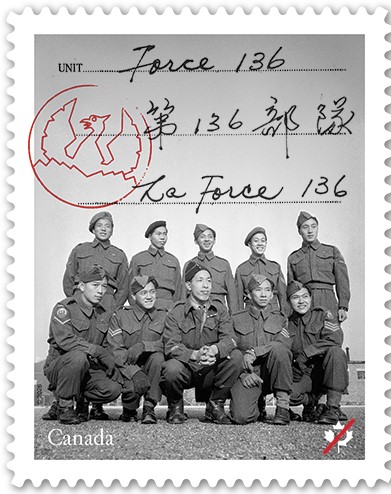
Despite facing racial discrimination at home, about 150 Chinese Canadians stepped forward for dangerous missions behind Japanese lines. Their service helped advance the Allied war effort and break down racial barriers in Canada. The stamp was unveiled today at an event at the Chinese Canadian Museum in Vancouver, attended by family and friends of the Chinese Canadians who volunteered for Force 136.
At the start of the Second World War, Chinese Canadians were initially barred from enlisting in military service due to racial discrimination. That changed in 1944, when Allied planners sought Chinese Canadians with language skills and the ability to blend in for covert operations in Japanese-occupied Asia.
Approximately 150 Chinese Canadians were recruited and served either with Force 136, part of Britain’s Special Operations Executive, or with Australia’s Services Reconnaissance Department for dangerous missions behind enemy lines. They underwent intense training in Canada and abroad, including in espionage, guerrilla warfare, parachuting, wireless operation and jungle survival. Their mission was to gather intelligence, support local resistance networks and carry out sabotage operations. They could expect to face extreme heat, insects and disease alongside the ever-present threat of capture, torture and death.
For the Chinese Canadian community, military service was about more than just supporting the war effort. At the time, Chinese Canadians were denied the right to vote and could not practise their profession; immigration from China was also heavily restricted by the Chinese Exclusion Act, 1923, also known as the Chinese Exclusion Act, leaving them as second-class citizens. Despite these barriers, many saw enlistment as a way to demonstrate their commitment to Canada and press for change.
“They wanted to prove that they were Canadians, and they thought the best way to do that was to fight for this country, even though they were treated as second-class citizens,” says Catherine Clement, community historian, author and curator.
While some members deployed overseas to locations such as Malaya and Borneo, others were still training when the conflict ended. By the end of the Second World War, more than 600 Chinese Canadians had served in all three branches of the Canadian military. Their service became part of a broader push for change at home. As a result, the 1923 Chinese Exclusion Act was repealed two years after the end of the Second World War, in 1947, and Chinese Canadians were granted full citizenship and the right to vote.